


Natchaug Hospital Inc
934 North Main Street, Danielson
Payment forms: Medicaid · Medicare · Private plans (insurance)
SAMHSA lists accreditation: Joint Commission
Care options
DetoxInpatient / residential rehabOutpatient care: IOP, PHPMedication for addiction (MAT)Treatment for dual diagnosisAlcohol use rehabDrug use rehabPrograms for particular groupsSober living / transitional housingHow rehab gets paid forCities
SAMHSA roster as pulled November 16, 2026
For many, care starts with detox. Staff stay close and manage withdrawal. Heavy drinkers who quit alone can face real danger. SAMHSA counts 14 listings in Connecticut with this care.
Before you dial, locate two things for whoever needs care: the insurance card and the ZIP code. This referral line is paid for: a partner answers, not any program on this list.
12 of 14 programs, per SAMHSA FindTreatment.gov reports, November 16, 2026. Sorted by the number of services reported to SAMHSA, most first, then A–Z. No fee is charged to programs for a listing; a partner foots the bill for this site's paid referral line. How the order is set.
Undecided where to begin? Call (475) 293-4042 This referral line is paid for: a partner answers, not any program on this list.
934 North Main Street, Danielson
Payment forms: Medicaid · Medicare · Private plans (insurance)
SAMHSA lists accreditation: Joint Commission
47 Coit Street, New London
Payment forms: Medicaid · Private plans (insurance)
SAMHSA lists accreditation: CARF
32 Wall Street, Madison
Payment forms: Medicaid · Medicare · Private plans (insurance)
500 Vine Street, Hartford
Payment forms: Medicaid · Medicare · Private plans (insurance)
SAMHSA lists accreditation: Joint Commission
Tynan Circle, Middletown
Payment forms: Medicaid · Medicare · Private plans (insurance)
SAMHSA lists accreditation: Joint Commission
232 Cedar Street, New Haven
Payment forms: Medicaid · Medicare · Private plans (insurance)
SAMHSA lists accreditation: Joint Commission
62 Carter Road, Kent
Payment forms: Private plans (insurance) · TRICARE
SAMHSA lists accreditation: Joint Commission
75 Swantown Hill Road, North Stonington
Payment forms: Medicaid · Private plans (insurance) · TRICARE
SAMHSA lists accreditation: Joint Commission
187 South Canaan Road, Canaan
Payment forms: Private plans (insurance) · Fees on a sliding scale
SAMHSA lists accreditation: CARF and Joint Commission
1250 Silver Street, Middletown
Payment forms: Medicaid · Medicare · Private plans (insurance)
SAMHSA lists accreditation: Joint Commission
402 East Main Street, Waterbury
Payment forms: Medicaid · Medicare · Private plans (insurance)
289 Windham Road, Willimantic
Payment forms: Private plans (insurance) · TRICARE
SAMHSA lists accreditation: Joint Commission
Facility details come from public agencies, with no advertiser input
SAMHSA's list for Connecticut shows 14 facilities with medical detox (November 16, 2026)[1]; Middletown (3), Hartford (2) and 9 more cities with 1 each has the largest number. 71% accept Medicaid; fees slide with income at 5.
What stands out
Who covers the bill for medical detox?
10 of the 14 facilities accept Medicaid and 5 bill on a sliding fee scale.
None of these listings provides free detox to all. Instead, 5 of the 14 facilities base prices on income, 9 tap county, state or federal funds when someone lacks coverage, and 4 report SAMHSA block grants. Those with no insurance can weigh these first; see lower-cost routes.
For that figure, feed the quote you got from a program into the cost calculator.
Free to call, confidential, 24/7. This referral line is paid for: a partner answers, not any program on this list.
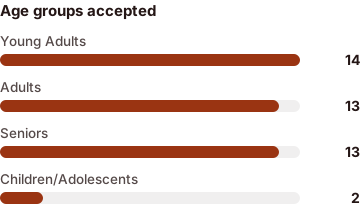
14 listings, counted by who they serve:
Most frequent: Young Adults (14 of 14), followed by Adults (13 of 14) and, third, Seniors (13 of 14).
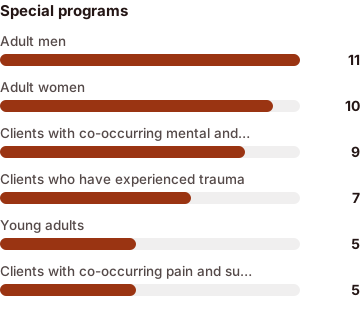
Most frequent: Adult men (11 of 14), followed by Adult women (10 of 14) and, third, Co-occurring disorders: mental illness together with substance use (9 of 14).
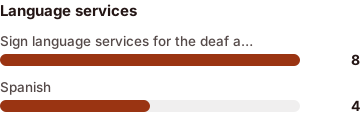
Most frequent: Sign language services for clients with hearing loss (8 of 14), then Spanish (4 of 14).
Programs report which settings they offer and what support continues after discharge.
Most frequent: Residential/24-hour residential (8 of 14), followed by Residential detoxification (8 of 14), Outpatient (7 of 14) and Outpatient medication treatment (methadone, buprenorphine, naltrexone) (7 of 14).

Most frequent: Assistance with obtaining social services (13 of 14), followed by Recovery coach (10 of 14) and, third, Mentoring/peer support (10 of 14).

Most frequent: Buprenorphine used in Treatment (14 of 14), followed by Naltrexone used in Treatment (14 of 14) and, third, Methadone used in Treatment (7 of 14).

Most frequent: Motivational interviewing (14 of 14), followed by Relapse prevention (14 of 14) and, third, Substance use disorder counseling (14 of 14).

Side by side, the 14 detox listings differ in setting: 5 run outpatient detox, meaning nights at home and trips to the program, usually daily in the first days, while 8 run residential detox, meaning you stay on site day and night, while 3 run hospital inpatient detox, where a hospital unit keeps medical staff close at hand. 1 run outpatient as well as live-in detox, so moving between the two does not mean changing programs.
Mild to moderate withdrawal is often manageable outpatient, provided a companion stays with you and the provider sees you each day until stable.[4] Moderate to severe cases may need inpatient care in a hospital or treatment facility, where staff track vital signs and stay watchful for delirium tremens.[4] Can't tell how severe it might get? Get assessed by the program first, then choose.
| Kind of setting | Listings | Highest count |
|---|---|---|
| Outpatient detox | 5 | Danielson (1), Madison (1), Middletown (1), New Haven (1) and Waterbury (1) |
| Residential detox | 8 | 8 cities with 1 each |
| Hospital inpatient detox | 3 | Middletown (2) and Hartford (1) |
Still torn between settings? Call (475) 293-4042 This referral line is paid for: a partner answers, not any program on this list.
Detox addresses withdrawal only, not the addiction; most people move on to longer treatment afterward.[5]
Alcohol
Typically sets in during the first 8 hours without a drink, though it can take days. Symptoms hit hardest 24 to 72 hours in; a few can linger for weeks.
Short-acting opioids such as heroin
Typically begins within 12 hours after final use. Hard to endure but not life-threatening.
Methadone
Typically begins within 30 hours after the final dose, so later than heroin.
Timing per MedlinePlus (NIH).[4][5]
Abruptly quitting after a long stretch of heavy drinking may trigger nausea, a racing pulse and seizures.[6] Delirium tremens is its severe form, marked by confusion, fever and hallucinations.[4] Treatment pairs sedatives with frequent checks of heart rate and blood pressure.[4] In Connecticut, alcohol detox appears in 11 out of 14 listings.
Methadone and buprenorphine both relieve withdrawal, and buprenorphine may shorten it too.[5] Buprenorphine is offered by all 14 listings, methadone by 7. 14 report routine medication use during detox.
Decide on the next stage before detox begins: counseling, intensive outpatient, a residential stay or medication.[5] 10 of these facilities run residential care too, and 3 intensive outpatient, so one care team can stay with you. Also see inpatient rehab and outpatient programs.
Below, each program that lists detox with SAMHSA (November 16, 2026) appears side by side, showing where detox takes place and whether HUSKY Health is accepted. Sites one organization runs in a single city are combined, so 14 SAMHSA listings become 14 rows. Open any program for its address, services and nearby alternatives.
| Program | City | Outpatient | Residential | Hospital-run | Medicaid |
|---|---|---|---|---|---|
| Mountainside Treatment Center | Canaan | No | Yes | No | No |
| Natchaug Hospital Inc | Danielson | Yes | No | No | Yes |
| Connecticut Valley Hospital | Hartford | No | No | Yes | Yes |
| InterCommunity Healthcare | Hartford | No | Yes | No | Yes |
| High Watch Recovery Center | Kent | No | Yes | No | No |
| Waterstone Counseling Center | Madison | Yes | No | No | Yes |
| Connecticut Valley Hospital | Middletown | No | No | Yes | Yes |
| Renew Health | Middletown | Yes | No | No | No |
| Rushford Center Inc | Middletown | No | Yes | Yes | Yes |
| Cornell Scott Hill Health Center | New Haven | Yes | Yes | No | Yes |
| SE Council on Alc and Drug Dep Inc | New London | No | Yes | No | Yes |
| Stonington Institute | North Stonington | No | Yes | No | Yes |
| StayWell Health Center | Waterbury | Yes | No | No | Yes |
| Rushford Center Inc | Willimantic | No | Yes | No | No |


14 facilities with medical detox, broken out by city
| City | Provides this | Every facility |
|---|---|---|
| Middletown | 3 | 10 |
| Hartford | 2 | 15 |
| Canaan | 1 | 2 |
| Danielson | 1 | 2 |
| Kent | 1 | 2 |
| Madison | 1 | 1 |
| New Haven | 1 | 17 |
| New London | 1 | 7 |
| North Stonington | 1 | 1 |
| Waterbury | 1 | 16 |
| Willimantic | 1 | 4 |
| Substance used | Facilities |
|---|---|
| Opioids | 14 |
| Benzodiazepines | 12 |
| Alcohol | 11 |
| Cocaine | 8 |
| Methamphetamines | 7 |
Undecided where to begin?
Middletown is home to 3 of the 14. Choose between contacting a program yourself and calling the referral line below.
This referral line is paid for: a partner answers, not any program on this list.
What separates one program from another
SAMHSA describes five marks of quality treatment. How Connecticut medical detox programs stack up on each, by their SAMHSA listings:
12 of the 14 Connecticut medical detox listings cite accreditation from CARF or the Joint Commission. Request the state license too; DMHAS is the licensing body for programs.
14 of 14 list medicines for opioid or alcohol use; methadone, naltrexone and buprenorphine are typical examples.
Evidence-based therapy appears in 14 of 14 listings, such as motivational interviewing, contingency management, or a course of cognitive behavioral therapy.
0 of 14 include family or couples therapy.
Recovery support once treatment ends (peer support, housing help) appears in 14 of 14.

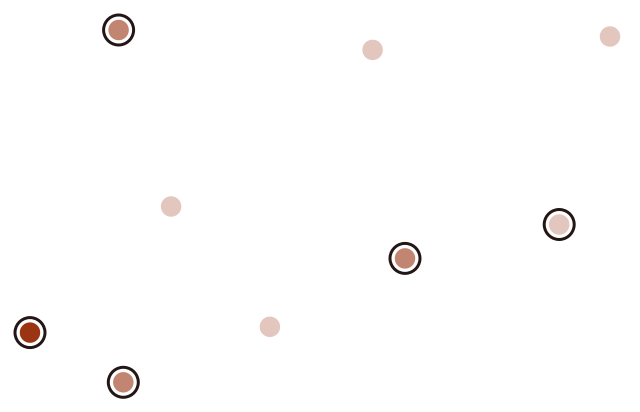
In Connecticut, we took each of the 9 counties and measured a straight line from its center to the nearest listed site offering medical detox. The median comes to 9.1 miles; 0 counties sit beyond 30 miles.
| County | Miles away |
|---|---|
| Western Connecticut Planning Region | 26.7 |
| Greater Bridgeport Planning Region | 16.4 |
| Northwest Hills Planning Region | 11.6 |
| Lower Connecticut River Valley Planning Region | 10.9 |
| Southeastern Connecticut Planning Region | 9.1 |
| Capitol Planning Region | 5.9 |
| South Central Connecticut Planning Region | 5.0 |
| Northeastern Connecticut Planning Region | 5.0 |
The Connecticut Rehab editors reviewed this on November 16, 2026, using the sources listed above. How the directory is made.
Medical detox in Connecticut: how options differ
In SAMHSA's FindTreatment.gov locator, medical detox appears at 14 of 213 addiction treatment locations in Connecticut, as of November 16, 2026.
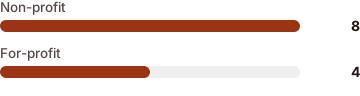
They're located across 11 cities in 7 counties; the table here ranks the leading 11 cities. By operator, 8 out of 14 are non-profits, and 0 are government-run, either by an agency or by the VA.
Middletown has the most, with 3, followed by Hartford (2) and 9 more cities with 1 each.
Among counties, Lower Connecticut River Valley Planning Region and Southeastern Connecticut Planning Region split the lead with 3 each. 6 additional cities have at least one; the complete directory of 213 centers shows the full set.
In most cases. HUSKY Health is accepted at 10 out of 14 facilities, compared with 8 for Medicare and 14 for private insurance.
No coverage? Weigh 5 income-based programs against 9 that draw on public funds. On HUSKY Health, the joint leaders are Hartford and Middletown, at 2 programs apiece. Billing differs from one of the 10 to the next; ask the program, or contact the referral line (paid; a partner answers).
Out of 14: 2 see children and adolescents, 2 offer veterans' tracks, 4 can work in Spanish; 4 take court-referred clients. Side by side, 1 of 2 teen programs take HUSKY Health, against 1 of 2 veterans programs that take TRICARE; can\'t decide among the 14? Any program can talk it through, or contact the referral line (paid; a partner answers).
Length varies with the substance and the amount taken.
With alcohol, withdrawal often sets in within 8 hours of stopping drinking and is worst from 24 to 72 hours, with some symptoms lasting weeks. For opioids, withdrawal sets in roughly 12 hours after a final dose of heroin, versus about 30 hours after methadone; one way to shorten it is buprenorphine. Addiction treatment usually goes on after detox is over.
Often, when symptoms stay in the mild to moderate range and another person can be with you. 5 out of 14 listings in Connecticut provide outpatient detox.
More serious withdrawal, moderate to severe, may require a hospital or another treatment facility. Both settings are offered at 1 facility here.
For many, care starts with detox.
Staff stay close and manage withdrawal. Heavy drinkers who quit alone can face real danger. Weigh it next to inpatient & residential rehab and outpatient, IOP & PHP; within this group of 14, 10 add residential care and 7 outpatient care. Where mental health matters too, 12 of the 14 handle it together with addiction.
Choosing between options for medical detox? Call (475) 293-4042 This referral line is paid for: a partner answers, not any program on this list.
Detox side by side