


Silver Hill Hospital Inc
208 Valley Road, New Canaan
Payment forms: Medicaid · Medicare · Private plans (insurance)
Care options
DetoxInpatient / residential rehabOutpatient care: IOP, PHPMedication for addiction (MAT)Treatment for dual diagnosisAlcohol use rehabDrug use rehabPrograms for particular groupsSober living / transitional housingHow rehab gets paid forCities
SAMHSA roster as pulled November 16, 2026
A residential stay gives you a bed on site, staff at all hours, and a fixed daily routine. Expect about 28 to 30 days; some stays run longer. SAMHSA counts 45 listings in Connecticut with this care.
Before you dial, locate two things for whoever needs care: the insurance card and the ZIP code. This referral line is paid for: a partner answers, not any program on this list.
12 of 38 programs (45 SAMHSA listings for 38 programs, folded into one card per organization), per SAMHSA FindTreatment.gov reports, November 16, 2026. Sorted by the number of services reported to SAMHSA, most first, then A–Z. No fee is charged to programs for a listing; a partner foots the bill for this site's paid referral line. How the order is set.
Undecided where to begin? Call (475) 293-4042 This referral line is paid for: a partner answers, not any program on this list.
208 Valley Road, New Canaan
Payment forms: Medicaid · Medicare · Private plans (insurance)
10 Signal Road, Stamford
Payment forms: Private plans (insurance)
SAMHSA lists accreditation: Joint Commission
401 West Thames Street, Norwich
Payment forms: Medicaid · Medicare
22 Masonic Avenue, Wallingford
Payment forms: Medicare · Private plans (insurance)
54 East Ramsdell Street, New Haven
Payment forms: Medicaid · Medicare · Private plans (insurance)
150 North Main Street, Manchester
Payment forms: Medicaid · Medicare · Private plans (insurance)
80 Prospect Street, Waterbury
Payment forms: Medicaid · Private plans (insurance) · TRICARE
70 Central Avenue, Waterbury
Payment forms: Medicaid
47 Long Lots Road, Westport
Payment forms: Medicaid · Medicare · Private plans (insurance)
313 Main Street, Norwich
Payment forms: Medicaid
99 Eastern Drive, Middletown
Payment forms: payment not on file with SAMHSA
62-64 Kent Cornwall Road, Kent
Payment forms: Medicaid
Facility details come from public agencies, with no advertiser input
SAMHSA's list for Connecticut shows 45 facilities with inpatient and residential rehab (November 16, 2026)[1]; Hartford (5), Middletown (5), Bethlehem (3) and Bridgeport (3) has the largest number. 69% accept Medicaid; fees slide with income at 10.
What stands out
Who covers the bill for inpatient and residential rehab?
31 of the 45 facilities accept Medicaid and 10 bill on a sliding fee scale.
For that figure, feed the quote you got from a program into the cost calculator.
Free to call, confidential, 24/7. This referral line is paid for: a partner answers, not any program on this list.
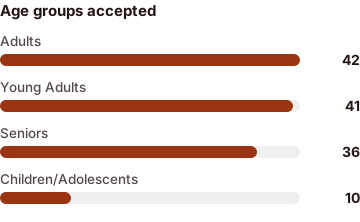
Of the 45 facilities: children and teens are welcome at 10, 12 list veterans' programs, and 13 have Spanish-speaking services.
Most frequent: Adults (42 of 45), followed by Young Adults (41 of 45) and, third, Seniors (36 of 45).
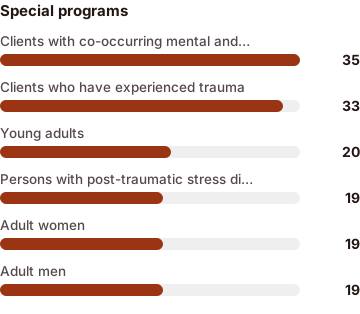
Most frequent: Co-occurring disorders: mental illness together with substance use (35 of 45), followed by Clients who have experienced trauma (33 of 45) and, third, Young adults (20 of 45).
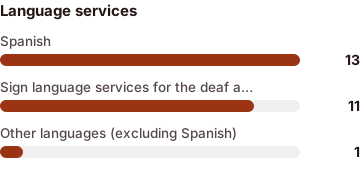
Most frequent: Spanish (13 of 45), followed by Sign language services for clients with hearing loss (11 of 45) and, third, Other languages (excluding Spanish) (1 of 45).
Programs report which settings they offer and what support continues after discharge.
Most frequent: Residential/24-hour residential (38 of 45), followed by Outpatient (17 of 45), Short-term residential (11 of 45) and Hospital inpatient/24-hour hospital inpatient (11 of 45).

Most frequent: Mentoring/peer support (34 of 45), followed by Housing services (26 of 45), Assistance with obtaining social services (21 of 45) and Recovery coach (21 of 45).

Most frequent: Buprenorphine used in Treatment (18 of 45), followed by Naltrexone used in Treatment (18 of 45) and, third, Methadone used in Treatment (7 of 45).

Most frequent: Cognitive behavioral therapy (37 of 45), followed by Motivational interviewing (23 of 45), Relapse prevention (23 of 45) and Substance use disorder counseling (23 of 45).


45 facilities with inpatient and residential rehab, broken out by city
| City | Provides this | Every facility |
|---|---|---|
| Hartford | 5 | 15 |
| Middletown | 5 | 10 |
| Bethlehem | 3 | 3 |
| Bridgeport | 3 | 15 |
| Fairfield | 2 | 3 |
| Kent | 2 | 2 |
| New Haven | 2 | 17 |
| New London | 2 | 7 |
| Norwich | 2 | 6 |
| Torrington | 2 | 8 |
| Waterbury | 2 | 16 |
| Willimantic | 2 | 4 |
| Canaan | 1 | 2 |
| Manchester | 1 | 3 |
| New Britain | 1 | 5 |
Placement follows ASAM criteria, which weigh risk of withdrawal, risk of relapse, readiness for change, the home environment, and needs in medical and mental health. Among Connecticut's 45 residential listings, 31 accept Medicaid, compared with 33 for private insurance.
Undecided where to begin?
Hartford is home to 5 of the 45. Choose between contacting a program yourself and calling the referral line below.
This referral line is paid for: a partner answers, not any program on this list.
What separates one program from another
SAMHSA describes five marks of quality treatment. How Connecticut inpatient and residential rehab programs stack up on each, by their SAMHSA listings:
18 of the 45 Connecticut inpatient and residential rehab listings cite accreditation from CARF or the Joint Commission. Request the state license too; DMHAS is the licensing body for programs.
23 of 45 list medicines for opioid or alcohol use; methadone, naltrexone and buprenorphine are typical examples.
Evidence-based therapy appears in 42 of 45 listings, such as motivational interviewing, contingency management, or a course of cognitive behavioral therapy.
18 of 45 include family or couples therapy.
Recovery support once treatment ends (peer support, housing help) appears in 39 of 45.

In Connecticut, we took each of the 9 counties and measured a straight line from its center to the nearest listed site offering inpatient and residential rehab. The median comes to 4.9 miles; 0 counties sit beyond 30 miles.

| County | Miles away |
|---|---|
| Lower Connecticut River Valley Planning Region | 11.6 |
| Western Connecticut Planning Region | 7.9 |
| Northeastern Connecticut Planning Region | 6.9 |
| South Central Connecticut Planning Region | 5.0 |
| Northwest Hills Planning Region | 4.9 |
| Naugatuck Valley Planning Region | 3.6 |
| Capitol Planning Region | 3.1 |
| Southeastern Connecticut Planning Region | 1.5 |
The Connecticut Rehab editors reviewed this on November 16, 2026, using the sources listed above. How the directory is made.
Inpatient and residential rehab in Connecticut: how options differ
In SAMHSA's FindTreatment.gov locator, inpatient and residential rehab appears at 45 of 213 addiction treatment locations in Connecticut, as of November 16, 2026.
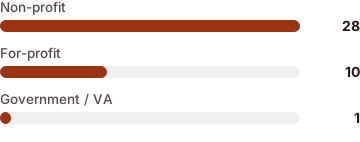
They're located across 25 cities in 9 counties; the table here ranks the leading 15 cities. By operator, 28 out of 45 are non-profits, and 1 are government-run, either by an agency or by the VA.
Hartford and Middletown come out even for the most, 5 apiece, followed by Bethlehem (3) and Bridgeport (3).
Among counties, Capitol Planning Region and Southeastern Connecticut Planning Region split the lead with 7 each. 20 additional cities have at least one; the complete directory of 213 centers shows the full set.
In most cases. HUSKY Health is accepted at 31 out of 45 facilities, compared with 19 for Medicare and 33 for private insurance.
No coverage? Weigh 10 income-based programs against 27 that draw on public funds. For HUSKY Health, Hartford comes out ahead with 5 programs. Billing differs from one of the 31 to the next; ask the program, or contact the referral line (paid; a partner answers).
Out of 45: 10 see children and adolescents, 12 offer veterans' tracks, 13 can work in Spanish; 15 take court-referred clients. Side by side, 3 of 10 teen programs take HUSKY Health, against 7 of 12 veterans programs that take TRICARE; can\'t decide among the 45? Any program can talk it through, or contact the referral line (paid; a partner answers).
A residential stay gives you a bed on site, staff at all hours, and a fixed daily routine. Expect about 28 to 30 days; some stays run longer.
Weigh it next to detox and outpatient, IOP & PHP; within this group of 45, 45 add residential care and 17 outpatient care. Where mental health matters too, 40 of the 45 handle it together with addiction.
Choosing between options for inpatient and residential rehab? Call (475) 293-4042 This referral line is paid for: a partner answers, not any program on this list.
Inpatient & residential rehab side by side