Capitol Region Mental Health Center
500 Vine Street, Hartford
Payment forms: Medicaid · Medicare
SAMHSA lists accreditation: Joint Commission
Care options
DetoxInpatient / residential rehabOutpatient care: IOP, PHPMedication for addiction (MAT)Treatment for dual diagnosisAlcohol use rehabDrug use rehabPrograms for particular groupsSober living / transitional housingHow rehab gets paid forCities
SAMHSA roster as pulled November 16, 2026
Medicare covers rehab at opioid treatment programs, clinics and hospitals alike. Medications are included, too. Compared with Medicaid, fewer private programs accept it. 148 programs here appear on SAMHSA's list.
Before you dial, locate two things for whoever needs care: the insurance card and the ZIP code. This referral line is paid for: a partner answers, not any program on this list.
12 of 148 listings, per SAMHSA FindTreatment.gov reports, November 16, 2026. Sorted by the number of services reported to SAMHSA, most first, then A–Z. No fee is charged to programs for a listing; a partner foots the bill for this site's paid referral line. How the order is set.
Undecided where to begin? Call (475) 293-4042 This referral line is paid for: a partner answers, not any program on this list.
500 Vine Street, Hartford
Payment forms: Medicaid · Medicare
SAMHSA lists accreditation: Joint Commission
231 North Main Street, Winsted
Payment forms: Medicaid · Medicare · Private plans (insurance)
SAMHSA lists accreditation: CARF
1250 Silver Street, Middletown
Payment forms: Medicaid · Medicare · Private plans (insurance)
SAMHSA lists accreditation: Joint Commission
212 Upton Road, Colchester
Payment forms: Medicaid · Medicare · Private plans (insurance)
402 East Main Street, Waterbury
Payment forms: Medicaid · Medicare · Private plans (insurance)
555 Willard Avenue, Newington
Payment forms: Medicaid · Medicare · Private plans (insurance)
SAMHSA lists accreditation: Joint Commission
101 Centerpoint Drive, Middletown
Payment forms: Medicaid · Medicare · Private plans (insurance)
SAMHSA lists accreditation: Joint Commission
60 Beaver Brook Road, Danbury
Payment forms: Medicaid · Medicare · Private plans (insurance)
SAMHSA lists accreditation: CARF
883 Paddock Avenue, Meriden
Payment forms: Medicaid · Medicare · Private plans (insurance)
SAMHSA lists accreditation: Joint Commission
67 Church Street, Norwich
Payment forms: Medicaid · Medicare · Private plans (insurance)
4 Midland Road, Waterbury
Payment forms: Medicaid · Medicare · Private plans (insurance)
SAMHSA lists accreditation: CARF
1549 Fairfield Avenue, Bridgeport
Payment forms: Medicaid · Medicare · Private plans (insurance)
Facility details come from public agencies, with no advertiser input
Medicare shows up at 148 programs out of 213 here (69%), compared with 180 for Medicaid. 71 of the Medicare programs include medication for opioid use. They cluster mostly in New Haven (15), Waterbury (12) and Hartford (11). Counts from the SAMHSA locator (November 16, 2026)[1].
What stands out
Under Part A: inpatient hospital stays, including inpatient detox. Under Part B: counseling as an outpatient, opioid treatment programs with methadone (added 2020) and intensive outpatient programs (added 2024). Under Part D drug plans: prescriptions like buprenorphine.
A residential program that isn't a hospital gets no Original Medicare coverage, and Original Medicare sets no annual ceiling on out-of-pocket spending. Medicare Advantage is different: each plan caps yearly costs, and some extend coverage within their networks.
Of these programs, 71 have medication for opioid use while 136 offer outpatient care. With Medicaid as well, Medicaid programs can cover care Medicare leaves out.
148 listings, counted by who they serve:
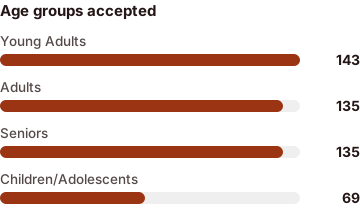
Most frequent: Young Adults (143 of 148), followed by Adults (135 of 148) and, third, Seniors (135 of 148).
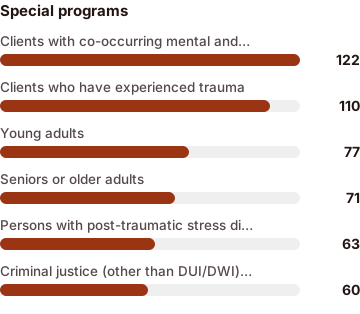
Most frequent: Co-occurring disorders: mental illness together with substance use (122 of 148), followed by Clients who have experienced trauma (110 of 148) and, third, Young adults (77 of 148).
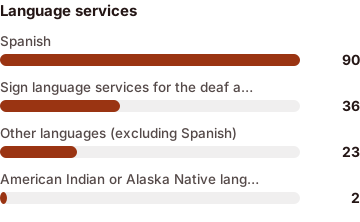
Most frequent: Spanish (90 of 148), followed by Sign language services for clients with hearing loss (36 of 148) and, third, Other languages (excluding Spanish) (23 of 148).
Programs report which settings they offer and what support continues after discharge.
Most frequent: Outpatient (136 of 148), followed by Regular outpatient treatment (48 of 148) and, third, Outpatient medication treatment (methadone, buprenorphine, naltrexone) (36 of 148).

Most frequent: Mentoring/peer support (89 of 148), followed by Housing services (68 of 148) and, third, Assistance with obtaining social services (51 of 148).

Most frequent: Naltrexone used in Treatment (45 of 148), followed by Buprenorphine used in Treatment (40 of 148) and, third, Methadone used in Treatment (13 of 148).

Most frequent: Cognitive behavioral therapy (144 of 148), followed by Telemedicine/telehealth therapy (113 of 148) and, third, Group therapy (90 of 148).

Undecided where to begin?
Before choosing, make sure each program accepts your Medicare plan.
This referral line is paid for: a partner answers, not any program on this list.
How the distance was measured: for all 9 counties of Connecticut, a straight line from the county's midpoint to the nearest facility on our list accepting Medicare. Typical (median) distance: 2.2 miles; the distance tops 30 miles for 0 counties.

| County | Miles away |
|---|---|
| Western Connecticut Planning Region | 7.6 |
| Northwest Hills Planning Region | 5.4 |
| Northeastern Connecticut Planning Region | 4.8 |
| Lower Connecticut River Valley Planning Region | 2.9 |
| Capitol Planning Region | 2.2 |
| Naugatuck Valley Planning Region | 1.8 |
| South Central Connecticut Planning Region | 1.3 |
| Southeastern Connecticut Planning Region | 0.8 |
How 148 programs accepting Medicare differ by level of care
Can't decide which program to ask? Call (475) 293-4042 This referral line is paid for: a partner answers, not any program on this list.


148 programs accepting Medicare, broken out by city
| City | Takes | Program total | Share |
|---|---|---|---|
| New Haven | 15 | 17 | 88% |
| Waterbury | 12 | 16 | 75% |
| Hartford | 11 | 15 | 73% |
| Bridgeport | 9 | 15 | 60% |
| Middletown | 9 | 10 | 90% |
| East Hartford | 8 | 8 | 100% |
| New Britain | 5 | 5 | 100% |
| Norwich | 5 | 6 | 83% |
| Danbury | 4 | 7 | 57% |
| New London | 4 | 7 | 57% |
| Stamford | 4 | 5 | 80% |
| Torrington | 4 | 8 | 50% |
What else do they take?
Plenty of programs accept several types of payment. That flexibility counts if your coverage shifts partway through treatment.
138 of the 148 take cash as well, while 102 offer sliding-scale fees.
Free to call, confidential, 24/7. This referral line is paid for: a partner answers, not any program on this list.
Counts of facilities: SAMHSA snapshot, November 16, 2026.
The Connecticut Rehab editors reviewed this on November 16, 2026, using the sources listed above. How the directory is made.
Medicare in context
Of 213 facilities in Connecticut, SAMHSA's locator lists 148 (November 16, 2026). Of those, 19 run residential care; 8 run detox. For opioid use disorder, 71 programs provide medication; 136 run outpatient care. Teens are welcome at 69 out of 148, and 90 serve Spanish speakers. To see which of the 148 can admit you, ask a program, or contact the referral line (paid; a partner answers).
Hospital inpatient care is covered by Original Medicare; residential programs located outside a hospital are not.
Some Medicare Advantage plans offer more; details are in your Evidence of Coverage document. Medicare is listed by 148 programs here; 19 provide residential care and 8 detox. Check with each whether its beds fall under hospital inpatient care, or contact the referral line (paid; a partner answers).
Yes.
Yes. Opioid treatment programs have been paid for by Medicare Part B since 2020, including methadone plus the counseling around it. In Connecticut, 71 out of 148 Medicare-listed programs provide opioid use disorder medication. Find out which of them is certified to operate as an opioid treatment program.
New Haven leads with 15, followed by Waterbury (12), Hartford (11), Bridgeport (9) and Middletown (9).
That comes to 88% when set against the 17 programs New Haven has listed. Overall, programs accepting Medicare are found in 51 Connecticut cities. To compare cities, the table here gives the leading ones and the portion of programs in each.
Of the 148, 144 take Medicaid, 141 take private insurance, 84 take TRICARE, 138 accept cash, 102 offer a sliding fee scale, and 124 report public funding. Background: Medicaid, private insurance, TRICARE, no insurance, or tally your share using the calculator.
Ask the programs above about the plans they accept, or try the referral line.
This referral line is paid for: a partner answers, not any program on this list.
How rehab gets paid for